At a blackjack table, the player in the last seat hits on 16. The dealer draws a ten, and someone complains that the player took the dealer’s bust card. Nobody could have known the next card in advance. The stronger test is whether a decision improves the expected value of a hand over repeated play, not whether one round ended badly.
Blackjack myths tend to confuse three different things: rules that set the house edge, cards already removed from a shoe, and stories about luck. Payouts and deck composition can matter. A lucky seat or a run of losses, by itself, does not. Similar mistakes appear in baccarat, poker and online card games.
Blackjack myths that confuse the rules with luck
Myth 1: You must get as close to 21 as possible
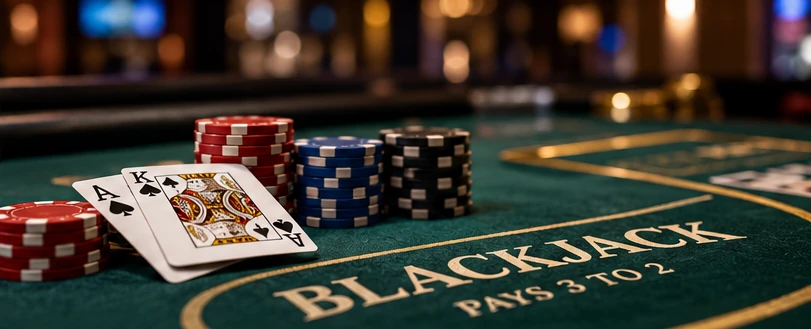
The objective of blackjack is to finish with a stronger hand than the dealer without exceeding 21. A total of 17 can win when the dealer busts; 20 can lose to 21. A natural blackjack is a two-card ace plus a ten-value card, and its payout may differ from an ordinary win. If your hand and the dealer’s finish on the same eligible total, the usual result is a push , with the original wager returned.
Chasing 21 is particularly risky on a hard hand: another card can take the total over 21. A soft hand contains an ace counted as 11 or 1, giving more room to draw. Whether to hit or stand depends on the dealer upcard and the applicable rules.
Myth 2: The player at third base can ruin the table
The final player before the dealer is known as third base. When that player draws a card that appears to have saved the dealer, the mistake sticks in everyone’s memory. When the same choice causes the dealer to bust, the table is less likely to blame anyone. Selective memory and confirmation bias make the first story feel more common than it is.
A different player decision can change which cards arrive next in an unreshuffled shoe. That is not proof that unconventional play at another seat reduces your expected return. Focus on your own strategy and the table’s rules rather than policing a stranger’s 16.
Myth 3: The dealer has a ten hidden underneath
Some blackjack formats give the dealer a face-down hole card ; others check for blackjack differently. Either way, assuming that the unseen card is always worth ten is poor reasoning. A fresh 52-card deck contains 16 ten-value cards: four each of tens, jacks, queens and kings. That is about 30.8% of the deck, not a certainty. Once cards have been exposed, the exact proportion may shift.
A six upcard does not guarantee a dealer bust; an ace does not guarantee blackjack. Use the visible upcard and the rules, not a guess about the hole card.
Myth 4: Never take a card if you might bust
Refusing every risky hit avoids some busts but leaves other hands losing to the dealer. Basic strategy compares hit, stand, double down, split pairs and surrender where available. The best expected-value decision may still lose that particular hand.
Strategy, insurance and card counting
Myth 5: Basic strategy guarantees a profit
Basic strategy selects moves with the best expected value under a specified rule set. It does not predict the next deal or eliminate variance. The correct chart may change between H17 (dealer hits soft 17) and S17 (dealer stands on soft 17), or when deck count, surrender and doubling after a split differ.
Check the payout for a natural blackjack before looking at any strategy chart. A NZ$10 winning blackjack pays NZ$15 profit at 3:2 but NZ$12 at 6:5. That NZ$3 difference increases the casino’s advantage on the same result. The table's posted payout is more informative than its minimum bet.
Myth 6: Insurance is protection for a good hand
Insurance is normally a separate side bet offered when the dealer shows an ace. It wagers that the dealer has a natural blackjack; it is not a refund policy for the player’s original hand. At the customary 2:1 insurance payoff, the dealer must have a ten-value hole card more than one-third of the time for the bet to be profitable on its own. Without special knowledge of the remaining card composition, that threshold is generally not met.
Even money, offered to a player holding a natural blackjack against an ace, is another form of the insurance decision. Compare it with the regular blackjack payout and the chance of a dealer blackjack before accepting it.
Myth 7: Card counting is either magic or universally illegal
Card counting tracks exposed cards to estimate whether high- or low-value cards are relatively abundant in the remaining shoe. In the Hi-Lo system , cards contribute to a running count ; dividing by estimated decks remaining produces a true count for multi-deck play. A discard tray and cut card help indicate how deeply a shoe is dealt, known as deck penetration .
A count cannot identify the next card. Its practical value depends on penetration, rules, limits, counting accuracy and bankroll. A continuous shuffling machine may erase the information needed for shoe counting; a machine that shuffles only between shoes is different. Even with a theoretical edge, short-term variance can lead to serious losses or risk of ruin.
Card-counting rules in Las Vegas do not settle the position in New Zealand. Venue conditions, conduct and the law are separate questions. Avoid claims that mental counting is categorically criminal or that casinos must allow it.
Why hot tables and betting systems feel convincing
Myth 8: After enough losses, the next win is due
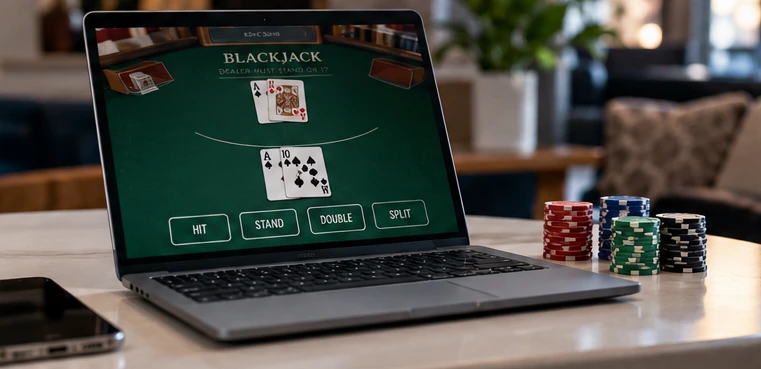
After five losing hands, a sixth win can feel overdue. That feeling is the gambler’s fallacy. Results on a scoreboard do not force the next deal to compensate for earlier losses; neither a hot table nor a cold dealer has an obligation to reverse course.
There is one genuine wrinkle. In a finite shoe that has not been reshuffled, drawn cards change the composition of what remains. That can affect probabilities. The useful record is which cards have left the shoe, not whether your previous five bets won.
Myth 9: A lucky seat, dealer or charm changes the cards
A new seat or lucky charm might make a player feel more confident. Neither changes a posted payout or the composition of the shoe by magic. Treat claims about a 'cold' dealer as an illusion of control, not as a way to forecast the next hand.
Switching tables can be rational when the second table offers a better blackjack payout, a different surrender rule or a suitable stake limit. Those differences can be checked; luck cannot.
Myth 10: Doubling your bet after a loss beats the casino
The Martingale betting system asks players to increase their stake after losses in the hope that a later win will recover earlier bets. It cannot turn a negative-expectation game into a favourable one. A run of six losses starting with NZ$10 would require the next stake to be NZ$640 under simple doubling, with NZ$630 already lost. Betting limits or an insufficient bankroll can stop the progression before the hoped-for recovery.
Flat betting, Martingale and increasing stakes after a hot streak all leave the underlying house edge intact. Chasing losses also exposes more money to risk.
Online blackjack, baccarat and poker myths
Myth 11: Online blackjack is always rigged - or always fair
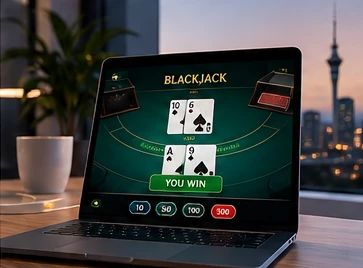
A blanket claim that online blackjack is rigged is no more useful than a blanket promise of fairness. RNG blackjack generates digital outcomes; live dealer blackjack uses physical cards streamed on video. Check the operator, the actual game rules, the applicable licensing position and credible game-specific testing. A laboratory logo alone is not proof that the game you selected was audited.
An automatic shuffler is not, by itself, evidence of cheating. Ask what it does and what evidence supports the allegation.
Myth 12: Baccarat roads predict the next hand
Baccarat offers Banker, Player and Tie bets with different payouts and house edges. Baccarat roads record previous Banker and Player results. A repeated sequence on the display is not reliable evidence for the next bet. Cards removed from a finite shoe can affect exact probabilities, but the visual pattern alone cannot tell you what comes next. The Tie bet generally carries a much larger house edge.
Myth 13: Poker is pure luck
Unlike a blackjack wager against a dealer, many forms of poker , including Texas Hold’em , involve decisions against other players. Card distribution is random, but hand ranges, position, pot odds, betting decisions and opponent tendencies can influence long-run results. Bluffing is one possible tactic, not a mandatory move every round. A strong starting hand, including pocket kings, can still lose after the community cards appear.
A bad beat in online poker is frustrating, but an unlikely run does not prove the game is rigged. Nor does it prove the operator is fair. Claims about integrity require independent evidence.
What New Zealand players should check before a card game
New Zealand’s Department of Internal Affairs (DIA) publishes authorised casino table-game rules , including Blackjack Game Rules, Division 2 (updated June 2025). The Gambling Act 2003 remains part of the framework. For internet casinos, the Online Casino Gambling Act 2026 came into force on 1 May 2026. The DIA says implementation is staged and the full licensing regime is not expected to be operational until 2027. A game's appearance on a published rules list does not mean every venue offers it.
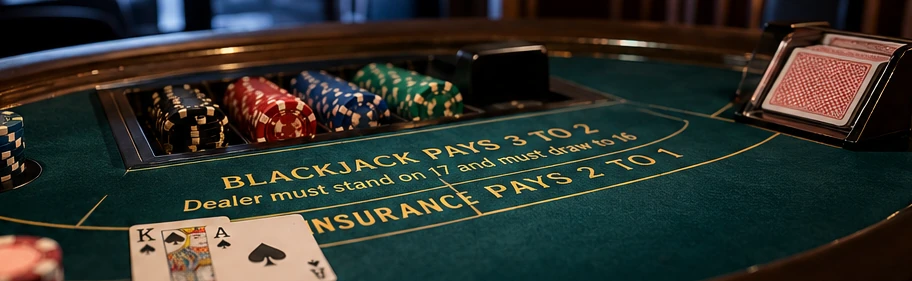
Before playing at a land-based casino, identify the exact game and check these details:
- Blackjack payout: is a natural blackjack paid at 3:2, 6:5 or another stated rate?
- Dealer rule: does the dealer hit or stand on soft 17?
- Player options: are double down, split pairs, doubling after splits and surrender allowed?
- Dealing procedure: how many decks, what reshuffling method and what hole-card procedure apply?
- Costs and limits: what are the table minimum, maximum, side-bet rules and stakes in NZD?
A site accepting NZ dollars is not necessarily licensed in New Zealand. During the staged introduction of the online casino licensing regime, check official DIA guidance rather than treating local marketing as evidence of authorisation.
The simplest test for a casino-card myth
For any card-game claim, ask: what rule changes, what probability changes, and where is the evidence? A move from 3:2 to 6:5 changes a payout you can calculate. A story that third base 'stole' the dealer’s bust card cannot establish a long-run disadvantage. A true count refers to cards remaining in the shoe; a win - loss display does not.
Even sound strategy cannot promise a winning session. Set a spending limit before play and avoid borrowing or increasing stakes to recover losses. Anyone concerned about gambling can contact Gambling Helpline New Zealand for confidential support.
Frequently asked questions
Can another player make me lose at blackjack?
They can alter the immediate order in which cards appear, but poor play at another seat does not reliably worsen your long-term odds. Evaluate your own decision and the game rules instead.
Does blackjack basic strategy always work?
It is designed to improve decision quality for a specified rule set, not to win every session. Use a chart matched to the number of decks, dealer soft-17 rule and permitted player actions.
Is card counting effective with continuous shuffling?
Continuous reshuffling generally prevents the persistent information about undealt cards that conventional shoe counting depends on. Results also depend on the machine and dealing procedure.
Is online blackjack legal in New Zealand?
A site accepting New Zealand players or showing NZ dollars does not establish local authorisation. Check the Department of Internal Affairs' current online-casino information before relying on the operator's status.
What is the most costly blackjack myth?
The most expensive misconception is that a losing streak makes bigger stakes safer. The next NZ$640 Martingale bet still carries risk, whatever happened in the previous six hands. Check payouts and set a limit instead of chasing a recovery.