The viral claims, checked
| Viral claim | Verdict | What to check |
|---|---|---|
| “A pokie is due after ten losing spins.” | False for independently generated results. | Random number generator (RNG) and game rules; previous spins do not create a debt. |
| “An RTP of 96% means I get $96 back from $100.” | Misleading. | RTP is a long-run statistical measure, not a session guarantee. |
| “This celebrity personally recommends the app.” | Unverified until independently authenticated. | Original channels, reporting and signs of deepfake or impersonation. |
| “The casino is already fully licensed in New Zealand.” | Requires verification. | The DIA's licensing timeline and, once operating, its official public register. |
| “A small verification deposit releases my winnings.” | Major scam warning sign. | Do not send further money; independently check the operator and contact your bank. |
Claim 1: “Pokies are due for a win”
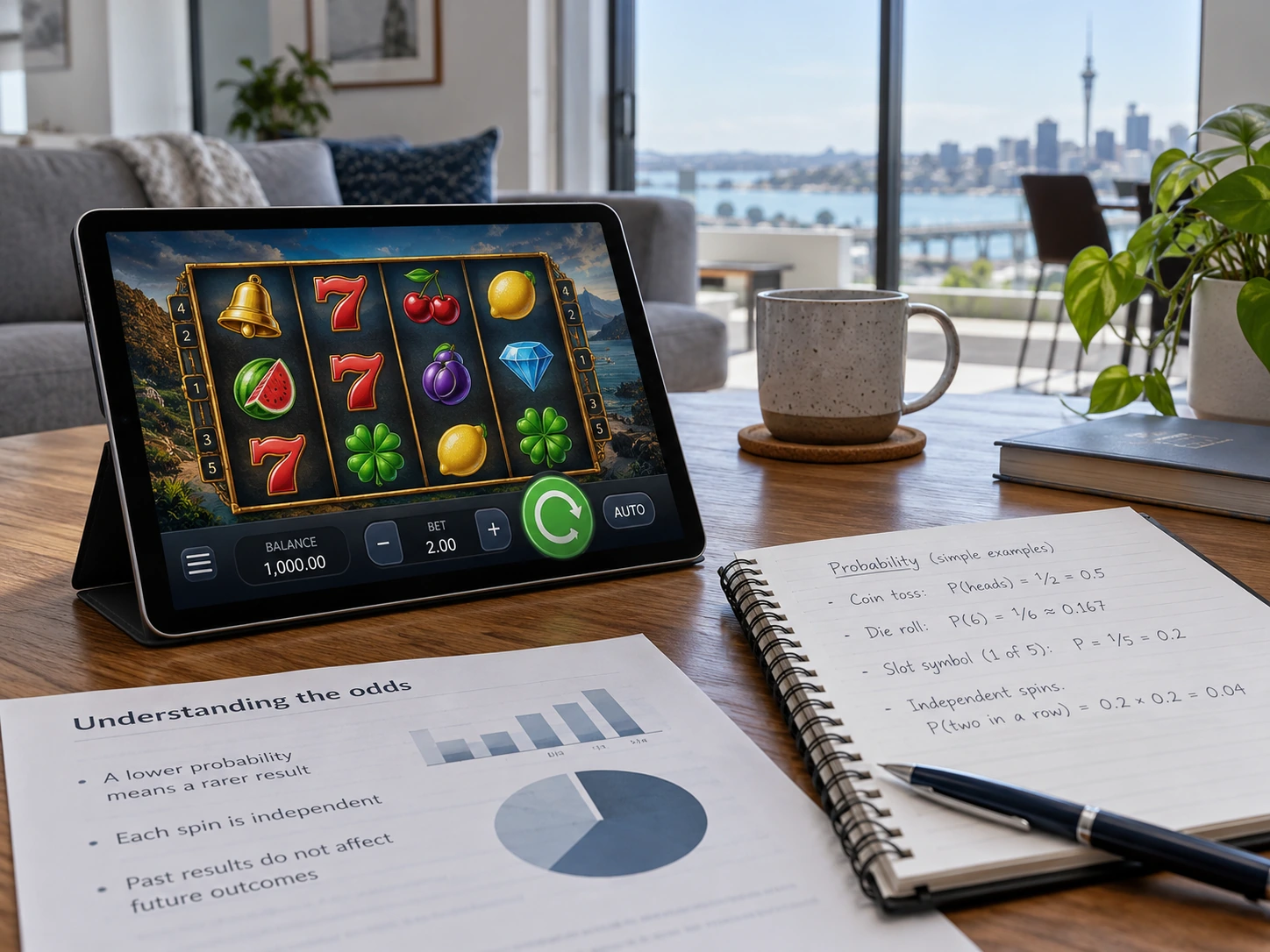
Verdict: False for games with independent random outcomes. The gambler's fallacy treats a losing run as if it creates a debt that the machine must repay. On an RNG-based slot with independent results, the tenth spin has no memory of the previous nine. A near miss - two jackpot symbols and a third just off the payline - can feel like progress, but it is not proof that the next result is closer to a jackpot.
Claims about “hot machines”, lucky numbers or the best time to spin need evidence from the game rules, not screenshots of wins. Progressive jackpots and promotions may work differently from standard spins; their terms must be checked separately.
Why a high RTP still allows heavy losses
Return to Player (RTP) expresses the proportion of stakes a game is designed to return across a very large volume of play, under specified conditions. The house edge is the mathematical counterpart: on a simple theoretical 96% RTP game, the implied edge is 4% of the amount staked. That says nothing about what one player will win or lose tonight.
Consider a hypothetical player staking NZ$2 per spin for 250 spins: their total amount wagered is NZ$500, even if their starting balance was much smaller because some wins were re-staked. At a theoretical 4% house edge, the mathematical expected loss on NZ$500 of cumulative stakes is NZ$20, not a forecast of the actual result. Volatility, jackpots and real-world game configuration can produce far larger wins or losses. The NZ$500 wagered matters more to this calculation than the opening deposit.
Lottery jackpot odds and sports betting have different mechanics: a Lotto NZ draw does not become easier to predict because a number has been absent, while TAB NZ sports odds also reflect pricing and bookmaker margin rather than certainty about an event. Past Lotto draws and a tipster's betting record cannot guarantee the next outcome.
Claim 2: “The TV presenter in this gambling ad approved it”

Verdict: A realistic-looking endorsement is not proof of consent. In April 2025, 1News reported that an AI-generated gambling promotion used the apparent likeness and voice of Breakfast presenter Jenny-May Clarkson and portrayed filmmaker Taika Waititi in a promotion for an app called “Māori Game”. Clarkson publicly rejected the impression that she had spoken in the video. The reported case is evidence of impersonation in gambling promotion; it does not authenticate the app or any winnings claimed in the advertisement.
A scammer can splice video, clone a voice or borrow the look of a news report. The link may lead to a copycat casino site. Even a familiar face or an appeal to Māori identity is no evidence that the person or community endorsed it.
Three checks before trusting an endorsement
- Find the original statement. Search the celebrity's verified channels and the broadcaster's own website, rather than a clip reposted by an advertiser.
- Separate reporting from promotion. A news outlet covering a suspected scam is not endorsing the product being investigated.
- Check the destination. An unfamiliar domain, pressure to act immediately, requests for ID or card details, and promises of risk-free cash are reasons to stop.
Lip-sync errors can raise suspicion, but convincing deepfakes may show none. Check whether the person or broadcaster actually published the endorsement.
Claim 3: Offshore casinos taking Kiwis are NZ-licensed

Verdict: False. New Zealand's Online Casino Gambling Act 2026 introduced a licensing framework, but commencement of a law does not mean every website serving New Zealand customers holds a local licence. According to the Department of Internal Affairs (DIA) , the regime is being implemented in stages, with licences expected from early 2027 and a fully operational licensed system expected during 2027.
As at 23 October 2026 , the DIA says online casino advertising to people in New Zealand is prohibited during the transition. An auction concluded in October with 11 entities securing the right to apply for up to 15 licences. Winning the right to apply is not the same as receiving a licence. Under the published transition timetable, from 1 December 2026 operators that have not applied must cease offering online casino gambling in New Zealand, while qualifying applicants may continue pending decisions subject to restrictions.
A site that opens in Aotearoa is not necessarily approved by DIA. An overseas licence is not an NZ licence, and a “regulated” badge on the casino's own website proves little. The DIA's player guidance says it will publish a public register of licensed providers once licensing begins. Until then, avoid treating claims of current NZ licensing as established fact.
The Gambling Act 2003 remains part of the wider regulatory history. The Online Casino Gambling Regulations 2026 add provisions for consumer protection, marketing, records and harm minimisation under the new framework. The online casino regime does not apply in the same way to Lotto NZ, TAB NZ or land-based casinos.
Claim 4: Another fee releases guaranteed winnings
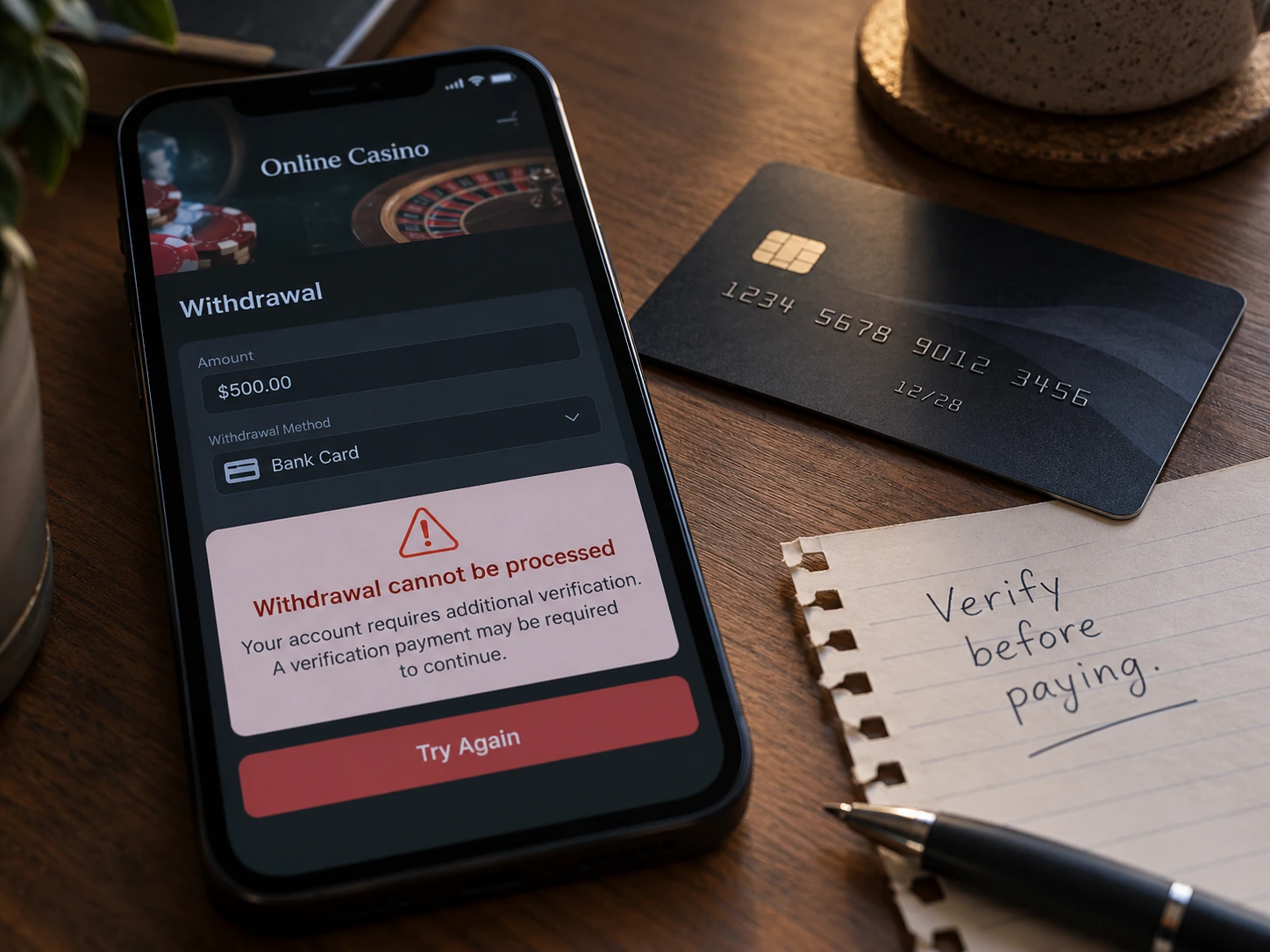
Verdict: A significant fraud indicator, not a reliable payment procedure. Fake gambling websites may show a fabricated balance, demand an additional “tax”, “verification payment” or “unlocking fee”, then invent another obstacle when a withdrawal is requested. A number on a screen does not mean the money can be withdrawn.
Legitimate services can require identity checks under their applicable rules, so a request for identity verification alone does not prove fraud. The sharper warning signs are an unexpected payment to release money, a transfer into a personal account or crypto wallet, threats of forfeiture unless a deadline is met, and support staff who refuse verifiable company information. A testimonial on the same site is not independent proof of payment.
If money or personal data has already been shared, stop sending payments, preserve the website address and messages, contact your bank or payment provider promptly, and report suspected deception through appropriate New Zealand channels. For misleading online casino advertisements, DIA lists onlinegambling@dia.govt.nz as a reporting contact. The Financial Markets Authority (FMA) also warns about deepfake-driven financial impersonation scams, although its investment-scam examples should not be mistaken for evidence about a specific casino.
Claim 5: Gambling harm affects daily players only
Verdict: False. Frequency alone cannot capture financial harm, relationship strain, psychological distress or effects on whānau. The Ministry of Health's Health and Independence Report 2025 states that, in 2023/24, 64.1% of people aged 15 or older reported gambling in the previous 12 months, 31.1% had gambled online, and 8.3% of adults experienced some form of gambling-related harm. The estimated NZ$2.79 billion in net gambling losses refers to four regulated sectors, not a count of scam losses or proof that everyone who gambled experienced harm.
The New Zealand Gambling Survey 2023/24 measures population patterns, not the risks of a particular casino app. Its measures should not be conflated: the Problem Gambling Severity Index (PGSI) gauges problem-gambling severity; the Short Gambling Harm Screen (SGHS) measures reported harm.
Researchers and harm-reduction organisations including Health New Zealand - Te Whatu Ora , PGF Services and Hāpai Te Hauora examine gambling's consequences beyond the money spent. The Ministry reports disproportionate impacts on Māori, Pacific peoples, some Asian communities and younger people. Those findings describe groups, not individuals.
Pokies can encourage rapid repeated play, while sports betting, lottery products and online casinos have different rhythms and exposures. Chasing losses can turn an attempt to recover money into further spending. Simulated gambling and loot boxes also deserve scrutiny, though their rules and financial risks differ from cash gambling.
How to fact-check a gambling claim in two minutes
- Capture the exact claim. Record the promised result, the URL, the date and whether it is labelled as an ad. “Always wins” is a different assertion from “some players have won”.
- Identify its type. A claim about probability needs game rules and mathematics; a claim about licensing needs DIA; a claim about a celebrity needs direct authentication; a claim about health effects needs credible research.
- Check the source, not its screenshot. Look for the original report, named author, publication date and primary data. Do not assume a copied 1News or TVNZ logo makes an ad a news report.
- Look for a disqualifier. Guaranteed outcomes, urgent upfront payments, unverifiable operators and supposedly current NZ licence badges during the transition are reasons not to proceed.
- Choose the safe next action. Do not deposit on the strength of a viral claim. Report suspicious advertising or seek support where needed.
Without the original footage, a reliable licence record or independent payment evidence, the proper verdict may be unverified , not false.
Where New Zealanders can verify information or get help
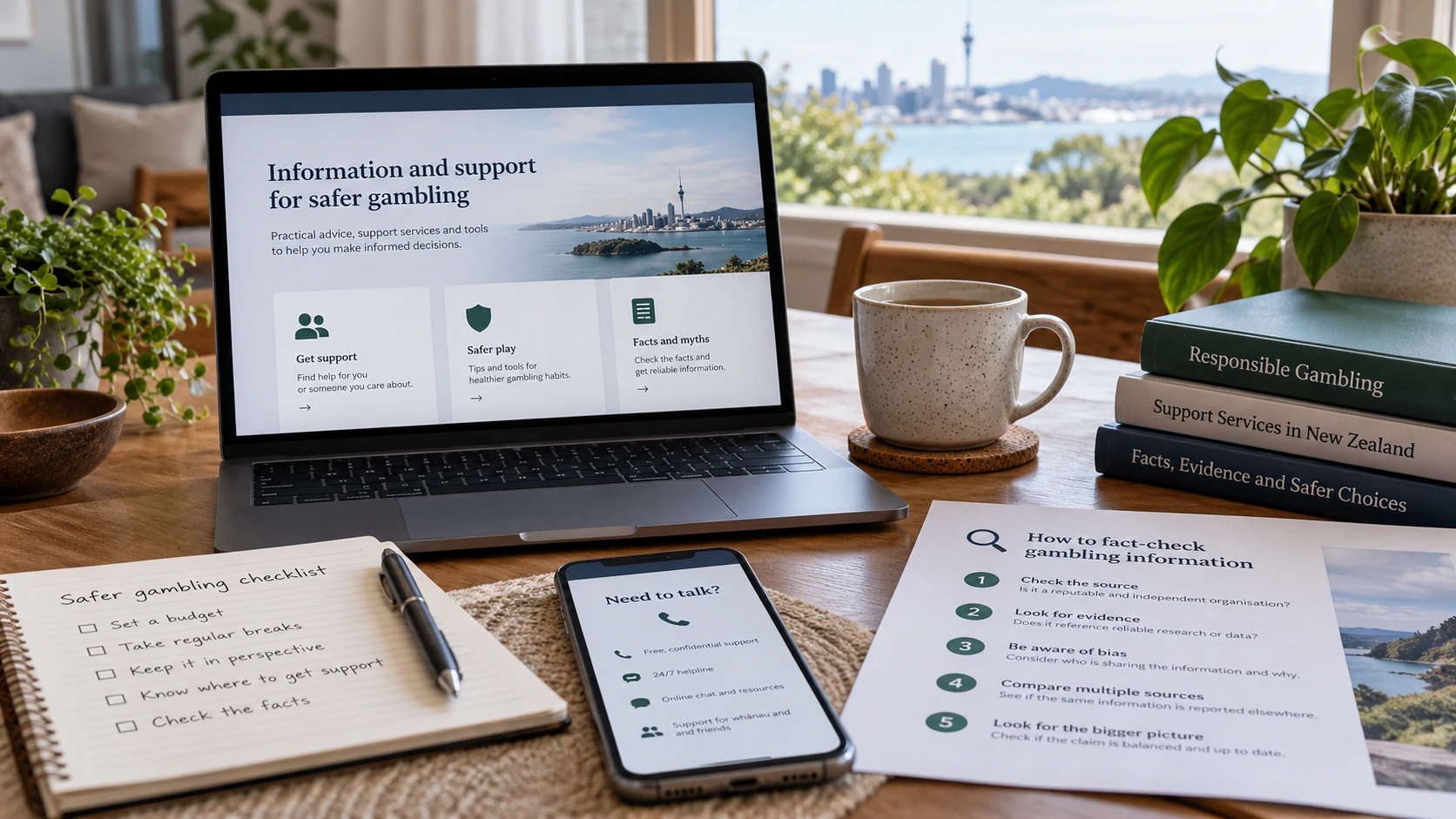
For operator status, advertising restrictions and the phased rollout of the new regime, use the Department of Internal Affairs . For population evidence and the New Zealand Gambling Survey , use the Ministry of Health . For gambling harm support, PGF Services lists the freephone number 0800 664 262 and text contact 5819 . Safer Gambling Aotearoa and the Gambling Helpline are additional New Zealand support pathways.
Do not send banking credentials or more identity documents to an unfamiliar casino site merely to “release” a prize.