
James Bond wins with a straight flush. A quiet man counts cards in Las Vegas. A roulette ball lands on 22 twice, giving a desperate couple a chance to escape. The most memorable gambling scenes do more than show someone getting lucky: the rules of the game reveal who holds the power, who is bluffing and what a loss could cost.
The rules are usually sound. The winning streaks are another matter. Knowing the difference changes how Bond's showdown, Raymond's blackjack run and Rick's roulette favour look on screen.

Casino Royale (2006): Why Bond's Final Poker Hand Wins
In Martin Campbell's Casino Royale , Daniel Craig's James Bond faces Le Chiffre (Mads Mikkelsen) in a high-stakes Texas Hold'em tournament in Montenegro. Bond's mission is not simply to win money. Le Chiffre needs funds, and defeating him at the table is a way to put pressure on the criminal financier. Vesper Lynd (Eva Green) and Felix Leiter (Jeffrey Wright) help make the contest part of a larger intelligence struggle.

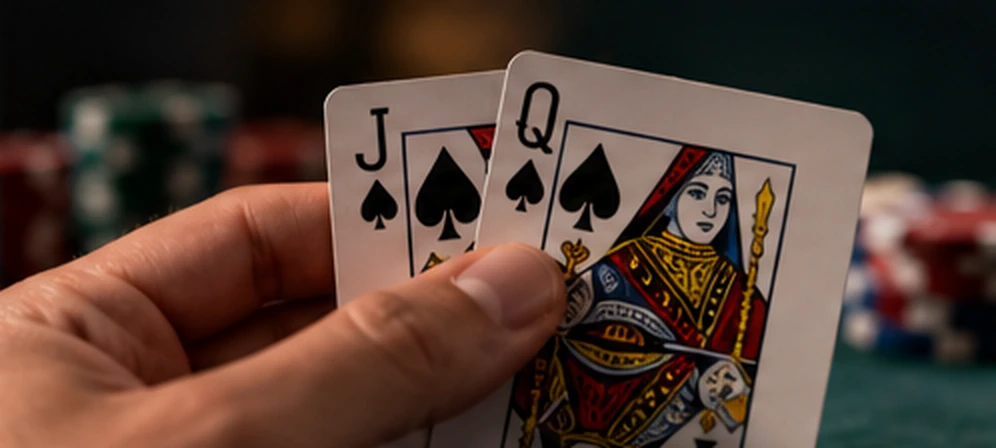
Each player receives two private cards and can combine them with five shared community cards to make the best five-card hand. In the final showdown, another player shows a flush, a second has a full house, and Le Chiffre reveals a stronger full house. Bond turns over the five and seven of spades to complete a four-to-eight straight flush in spades . A straight flush beats any ordinary full house, so Bond takes the pot.
The reveal comes in stages: flush, full house, better full house, then Bond's straight flush. The ranking is correct, though four exceptional holdings in one decisive hand make for better cinema than representative poker. Ian Fleming's novel also used baccarat, not Hold'em.
Rounders: Teddy KGB's Oreo tell and the bluff's cost
In John Dahl's Rounders , Mike McDermott (Matt Damon) returns to the underground poker world to face Teddy KGB (John Malkovich). Mike's friend Worm (Edward Norton) has helped pull him into trouble, and the final confrontation puts Mike's bankroll and future at risk.
Mike notices that Teddy handles his Oreo biscuits differently depending on the strength of his hand. That behavioural clue is a tell : an observable habit that might reveal information a player wants to conceal. Mike uses his read to make an aggressive decision and, later, outplays Teddy in their heads-up confrontation.
The biscuit habit is a clue, not a code. Mike still has to judge Teddy's bet and decide how much risk to take. A bluff can force a stronger hand to fold; a read based on one gesture can just as easily be wrong, especially against someone who knows he is being watched.
Rain Man: card counting doesn't predict the next card
Barry Levinson's Rain Man brings Charlie Babbitt (Tom Cruise) and his brother Raymond (Dustin Hoffman) to a Las Vegas blackjack table. Charlie realises that Raymond's exceptional memory and attention to numerical patterns might help them win.
Blackjack players aim to finish nearer to 21 than the dealer without exceeding it. Card counting tracks the approximate balance of high and low cards remaining in a shoe. Under some rules, a deck richer in tens and aces can improve a player's expected return. It does not reveal the next card or make every hand a winner.
The sequence uses Raymond's mathematical ability to change the brothers' relationship, but the film makes a complex advantage-play technique look rapid and almost magical. For a viewer trying to distinguish fact from fiction, the key test is simple: counting shifts a statistical expectation over many hands; it does not guarantee the result of an individual hand.
21 (2008): The MIT Blackjack Team Versus Hollywood
Robert Luketic's 21 follows Ben Campbell (Jim Sturgess), who joins a student card-counting operation led on screen by professor Micky Rosa (Kevin Spacey). The film draws loosely on the real MIT Blackjack Team and Ben Mezrich's book Bringing Down the House .
Team members observe dealt cards and relay information when the remaining shoe appears favourable. A spotter can track the count while a designated big player arrives to make larger bets. Unlike a lone genius memorising every card, the team's advantage comes from coordination, discipline and bankroll management.
MIT has explicitly described 21 as a fictional work loosely based on its students' history, and the film's professor is not a real MIT faculty member. The counting concept and the broad team structure are genuine; the personal betrayals, confrontations and security drama are shaped for a crime thriller. Card counting itself is not the same as marking cards or altering the deck. Casino responses and applicable rules vary by jurisdiction, so American scenes should not be treated as evidence of New Zealand law.
The Hangover: Alan's blackjack win is a comic shortcut
In Todd Phillips's The Hangover , Alan Garner (Zach Galifianakis) takes the card-counting role during a desperate attempt to raise money in Las Vegas. The sequence nods to Rain Man , using onscreen calculations and a sudden winning streak as visual shorthand for extraordinary concentration.
The joke depends on speed: Alan's apparent competence arrives precisely when the group needs it. The real distinction is between a strategy that may improve long-run expectations and a film montage that selects only the exciting hands. Even a player using accurate basic strategy and a favourable count can lose money over a short session.
Casablanca (1942): Why Rick Tells the Couple to Bet on 22
Michael Curtiz's Casablanca turns a roulette spin into a moral choice. At Rick's Café Américain, a young Bulgarian couple need money to leave Casablanca. Rick Blaine (Humphrey Bogart), ordinarily guarded and unsentimental, tells the husband to try number 22. The number hits, Rick tells him to leave the winnings there, and 22 lands again.

A straight-up bet on one number typically pays 35 to 1. On a European-style single-zero wheel, the probability of hitting a specified number on one fair spin is 1 in 37; two independent consecutive hits would be 1 in 1,369. Those figures describe an ordinary fair wheel, not necessarily the circumstances depicted in the film.
Rick's knowing exchange with the croupier changes the meaning of the wins: he is quietly helping the couple leave. The number matters because of that decision, not because 22 is a clever bet. The screenplay makes the cooperation particularly clear.
The Cincinnati Kid (1965): Full House Versus Straight Flush
Norman Jewison's The Cincinnati Kid pits Eric “The Kid” Stoner (Steve McQueen) against seasoned champion Lancey “The Man” Howard (Edward G. Robinson) in a New Orleans five-card stud game. Unlike Texas Hold'em, traditional five-card stud deals players individual cards, with some exposed during betting.
The Kid reaches a full house, but Lancey reveals a straight flush. The latter outranks the former, ending the younger player's challenge. Poker enthusiasts have long debated how wildly unlikely the climactic matchup is. The correct conclusion is not that the ranking is wrong; it is that the screenplay favours maximum drama over ordinary hand frequency.
The Kid loses more than the pot. Lancey's straight flush punctures his belief that talent makes him unbeatable.
Lock, Stock: a rigged Three-Card Brag game
Guy Ritchie's London crime film starts its central disaster when Eddie (Nick Moran) and his friends pool their money to enter a game run by Hatchet Harry (P. H. Moriarty). Bacon (Jason Statham), Tom (Jason Flemyng) and Soap (Dexter Fletcher) believe Eddie's skill will protect their stake.
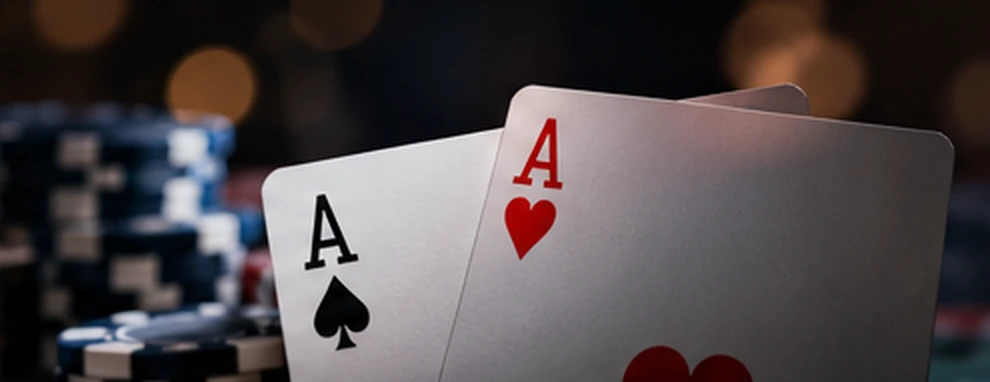
The film's game is three-card brag , a British three-card gambling game, not a Texas Hold'em tournament. Players receive three cards; hand categories and betting conventions differ from familiar five-card poker. Eddie loses because the contest is manipulated, not because a fair sequence of cards simply goes against him.
The debt that follows drives the robbery plot. Eddie thought he was paying to test his skill; Harry had arranged the result.
Molly's Game (2017): When the Best Hand Still Loses
Aaron Sorkin's Molly's Game follows Molly Bloom (Jessica Chastain), who organises exclusive, high-stakes poker games. The most revealing table drama concerns Player X (Michael Cera), who pressures a less experienced opponent into folding a winning hand.
In poker, the nuts means the strongest possible hand given the cards visible. A player holding the nuts at a completed showdown cannot be beaten by a higher-ranked hand, yet may still fold before showing their cards if persuaded that their reading is wrong. The film's scene is about confidence and intimidation rather than miraculous cards: the wealthy and experienced can weaponise status against an uncertain newcomer.
Bloom's real life inspired the film, but its characters and incidents are selectively combined and dramatised. Player X is not a reliable one-to-one portrait of a single named celebrity.
Casino (1995): The House's Power Is the Story
Martin Scorsese's Casino takes a different approach. Sam “Ace” Rothstein (Robert De Niro), Ginger McKenna (Sharon Stone) and Nicky Santoro (Joe Pesci) inhabit a Las Vegas world where surveillance, management and organised crime matter as much as what happens on the casino floor.
A casino with a built-in house edge need not win every wager. Over repeated play, that advantage favours the operator. Scorsese is more interested in who runs the floor, controls the money and watches the staff than in one remarkable winning hand.
More Gambling Scenes in Films and Television
The Sopranos: Debt Outlasts the Poker Night
In the season-two episode “The Happy Wanderer”, Tony Soprano (James Gandolfini) permits Davey Scatino (Robert Patrick) to join the Executive Game despite his financial vulnerability. Davey's debt becomes leverage that reaches far beyond the table. The episode's most accurate emotional observation is that the consequences of gambling do not end when a hand is dealt.
Twin Peaks: “Mr Jackpots” and slot fantasy
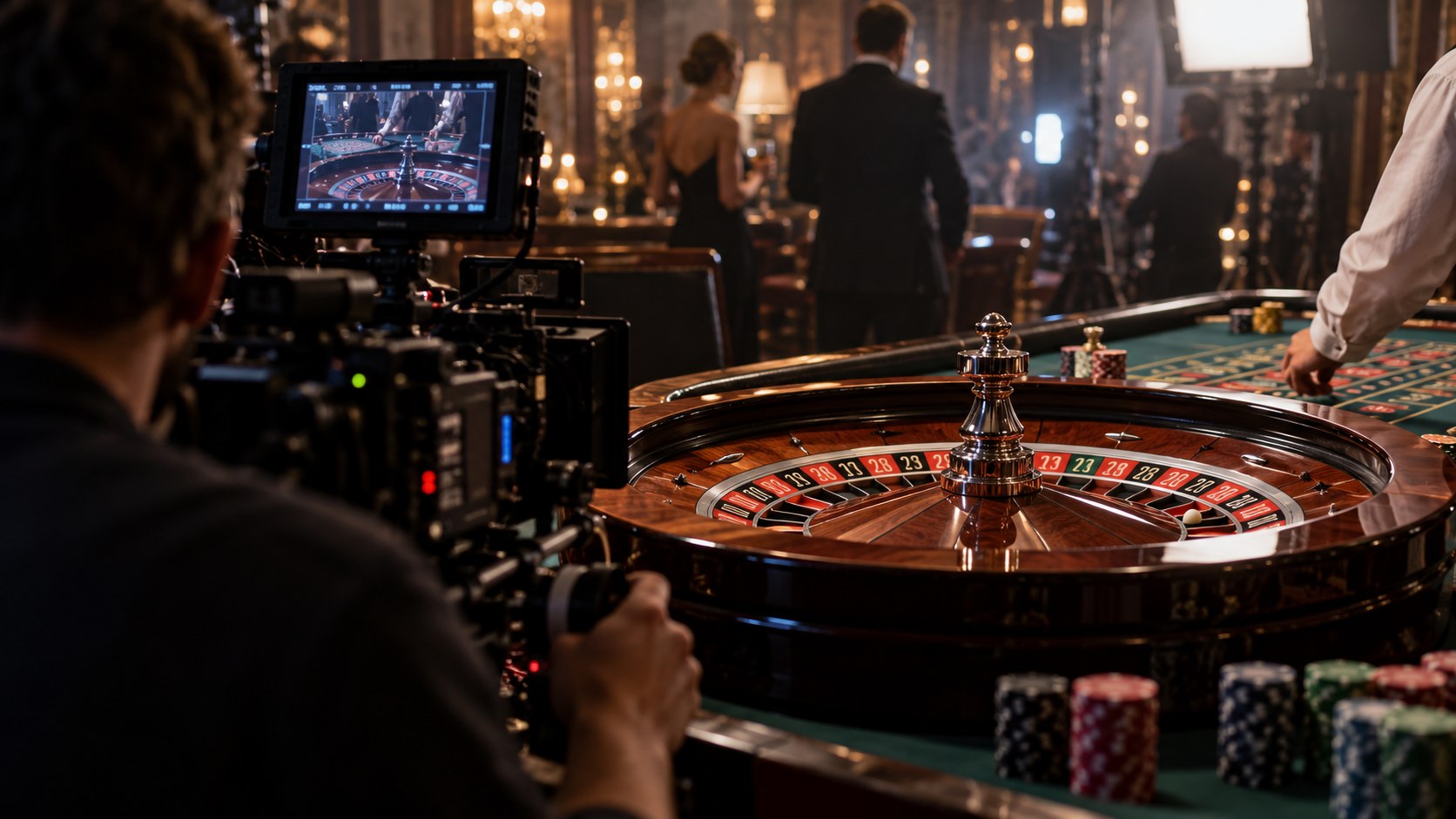
David Lynch's Twin Peaks: The Return sends Dougie Jones (Kyle MacLachlan) through a casino where his uncanny slot-machine success earns him the nickname “Mr Jackpots”. Slot machines use chance-based outcomes; Dougie's apparent supernatural guidance belongs to the show's dreamlike storytelling, not to an exploitable feature of real machines.
The Sting, Maverick and Other Gambling-Adjacent Classics
The Sting (1973) uses a crooked high-stakes card game to stage a battle of deception; Maverick (1994) plays poker as comedy and character contest. Dr. No (1962) introduces Sean Connery's Bond at a baccarat/chemin de fer table, while Run Lola Run (1998) makes roulette a frantic expression of chance and urgency. Uncut Gems (2019), starring Adam Sandler as Howard Ratner, moves the pressure toward sports betting and escalating personal risk.
Ocean's Eleven (2001) centres on a casino heist rather than a player's decisions at the table. Other screen portrayals range from the compulsion in Owning Mahowny and the prison wager in Cool Hand Luke to comic bets in Peep Show, Only Fools and Horses and The Simpsons.
How to Tell Whether a Gambling Scene Is Realistic
| On-screen moment | What is plausible | What cinema exaggerates |
|---|---|---|
| Poker tells and bluffs | Betting patterns and behaviour can inform a decision. | One gesture almost never provides absolute certainty. |
| Huge final poker hands | Straight flushes and full houses are valid hands. | Multiple rare hands converge far more often in scripts than in routine play. |
| Blackjack card counting | Tracking card composition may improve expected value under suitable rules. | Counting does not predict exact cards or assure a winning session. |
| Roulette streaks | A number can appear twice consecutively. | Previous spins do not make a number “due” on a fair independent wheel. |
| Casino victories | Individual players sometimes win. | Montages conceal losses, variance, table limits and the house edge. |
| Underground games | Credit, intimidation and cheating can affect outcomes. | Plots condense complex debts and criminal consequences into a single night. |
A useful test is to ask three separate questions: Does the winning hand obey the rules? How likely is this outcome under fair play? Is someone manipulating the game or the opponent? Casino Royale passes the first test while stretching the second; Casablanca hints at the third; Lock, Stock makes manipulation its central premise.
Why These Scenes Stay Memorable
Gambling provides a compact narrative machine. The cards expose incomplete information, betting converts belief into risk, and the final reveal forces a character to live with a choice. In Rounders , the central question is whether Mike can trust his read. In The Cincinnati Kid , it is whether confidence has become arrogance. In Casablanca , gambling offers cover for compassion. In The Sopranos and Uncut Gems , the suspense comes from the damage a character cannot stop accumulating.
Whether the setting is Montenegro, London or Las Vegas, a dramatic win should not be confused with a dependable way to make money. The hands can be checked against real rules. The characters' choices are what make the scenes worth watching.
Frequently Asked Questions
What is the most famous poker scene in a James Bond film?
The final Texas Hold'em showdown in Casino Royale (2006) is among the best known. Bond wins with a straight flush. The original novel's central casino game is baccarat.
Is card counting the same as cheating?
Mentally tracking cards is different from physically marking or altering them. However, casinos may restrict play, and the legal position depends on where and how the activity occurs. The American situations in Rain Man and 21 do not establish New Zealand-specific legal rules.
Could roulette land on 22 twice as in Casablanca?
Yes. With independent fair spins on a single-zero wheel, a specified number has a 1-in-37 chance on each spin. The scene also suggests cooperation between Rick and the croupier, so it is not presented as an ordinary strategy for beating roulette.
Does Lock, Stock show Texas Hold'em?
No. Eddie enters a rigged game of three-card brag, whose three-card hands and betting rules are distinct from Texas Hold'em.
Is 21 based on real MIT students?
Yes, loosely. MIT students participated in blackjack teams using card-counting methods, but the film changes people and events. MIT has identified the professor portrayed in the film as fictional.
Which gambling film shows the risks?
Owning Mahowny , Uncut Gems and the Davey Scatino storyline in The Sopranos place financial and personal consequences at the centre. They offer a useful counterpoint to spectacular cinematic wins.