House edge is the mathematical advantage built into a casino game. A 4% house edge means the game is designed to retain an average of NZ$4 for every NZ$100 wagered over the long run, not that every player loses NZ$4 on a NZ$100 deposit. The distinction matters: deposits, total bets, expected losses and actual session results are four different numbers.
To compare games, start with the published return to player (RTP) and the rules for the version being offered. Then work out the cost against your likely total wagers, not your deposit.
What is the house edge?

The terms house advantage and casino advantage mean the same thing. Casino payouts are set below the fair odds of an outcome. A game can pay frequent prizes and still make money for its operator over enough wagers.
Consider European roulette. Its wheel has 37 pockets: numbers 1 - 36 and one zero. A straight-up bet wins with probability 1/37, yet a winning bet pays 35:1 rather than the 36:1 net odds that would make the wager fair. For a NZ$1 straight-up bet, the net expected value is (1/37 × NZ$35) − (36/37 × NZ$1) = −NZ$0.0270, or a 2.70% house edge .
Expected value (EV) averages every possible net outcome according to its probability. Here, the player's EV is negative. Nothing in that calculation predicts the next spin or the end of a session.
How to calculate house edge and expected loss
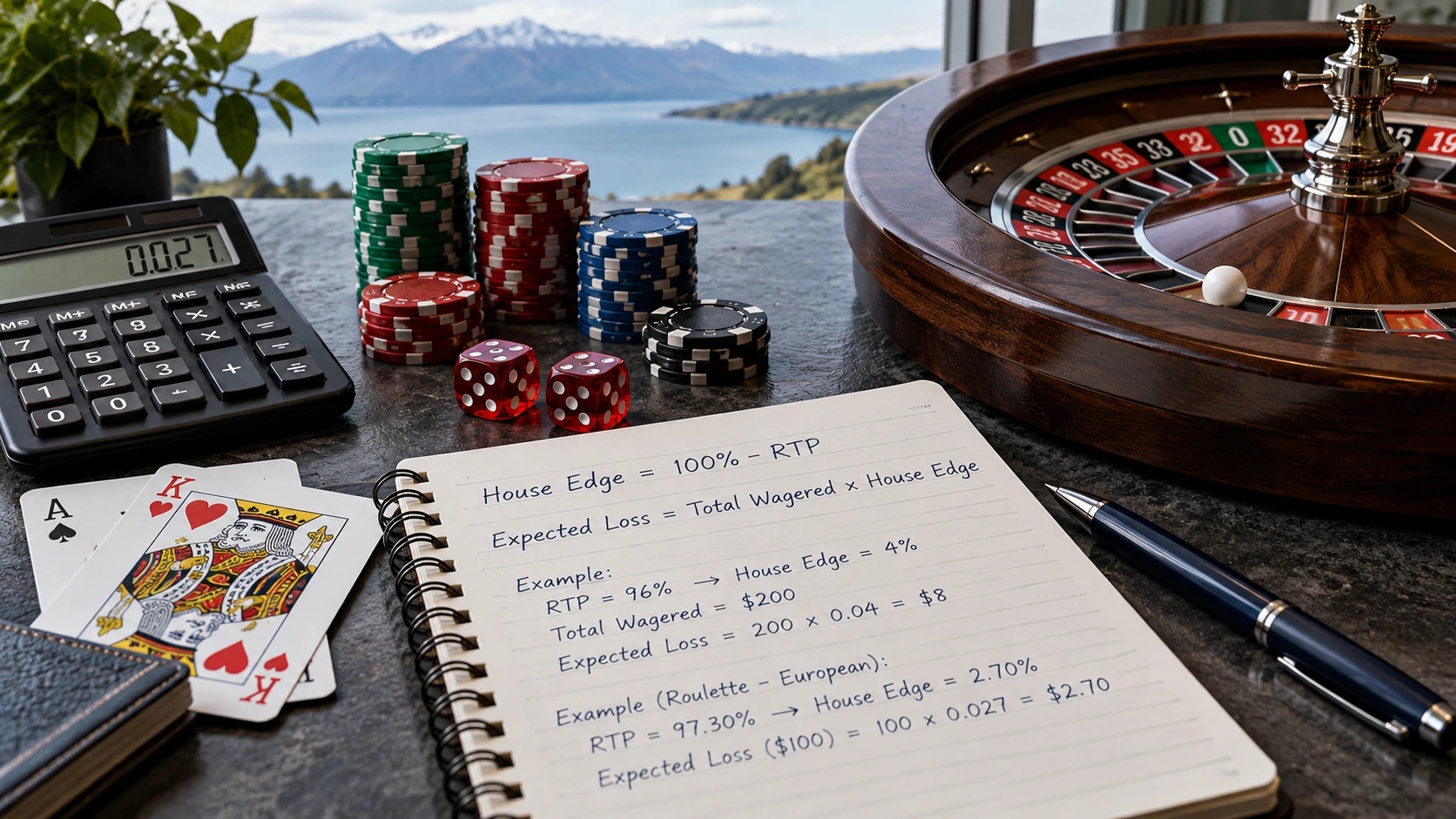
When RTP and house edge use the same betting base:
House edge (%) = 100% − theoretical RTP (%)
Expected loss (NZ$) = total amount wagered (NZ$) × house edge (as a decimal)
A pokie with a published 96% theoretical RTP has a corresponding 4% house edge. If cumulative wagers reach NZ$500, the mathematical expected loss is NZ$20. A particular session can end well above or below that figure.
| Total wagers | Theoretical RTP | Expected loss |
|---|---|---|
| NZ$100 | 96% | NZ$4 |
| NZ$500 | 96% | NZ$20 |
| NZ$2,000 | 96% | NZ$80 |
Turnover is not the amount deposited. Someone might deposit NZ$100, repeatedly stake winnings and eventually accumulate NZ$500 in bets. Their estimated theoretical cost at a 4% edge would be based on NZ$500 of turnover, not the initial NZ$100. Raising the stake or playing more rounds increases expected monetary loss even when the percentage edge remains unchanged.
For games involving multiple decisions or extra wagers, such as blackjack, the conventional house edge may be quoted relative to the initial bet. The element of risk instead divides expected loss by the total money put at risk, including additional stakes. Do not compare figures across different denominators without checking the calculation method.
House edge vs RTP: why 96% does not mean a 96% refund
Return to player (RTP) is the share of total stakes a game is designed to pay back over the long run. A 96% RTP corresponds to a 4% theoretical edge only when both figures cover the same rules, version, bet types and strategy assumptions. They are not separate fees.
Theoretical RTP comes from the game's mathematics and paytable. Observed RTP is the percentage actually returned across a set of spins. In a short session, observed results can be far above or below the advertised number. The law of large numbers explains why averages tend to settle towards expected values as the number of comparable independent trials becomes very large; it does not require an individual player's balance to recover.
A hit frequency of 30%, for example, might mean approximately 30% of spins trigger some payout, but it says nothing by itself about profitability. A payout smaller than the original stake remains a net loss on that spin. Hit frequency, RTP and house edge answer different questions.
House edge by casino game
The rates below apply to the specific bets and rules listed. Change the bet, commission, paytable or strategy and the figure may change.
| Game or bet | House edge | Key condition |
|---|---|---|
| Blackjack | About 0.5% | Favourable rules and accurate basic strategy; actual edge varies |
| 9/6 Jacks or Better video poker | About 0.46% | Full-pay 9/6 paytable and optimal play |
| Baccarat - Banker | About 1.06% | Standard 5% winning-Banker commission |
| Baccarat - Player | About 1.24% | Standard baccarat rules |
| French roulette | About 1.35% | La partage applies to eligible even-money bets |
| Craps - Pass Line | About 1.41% | Standard line bet before additional odds |
| Craps - Don't Pass | About 1.36% | Standard rules including the bar 12 provision |
| European roulette | About 2.70% | Single-zero wheel, standard bets |
| Pokies / slots | 4% in this example | Specific version showing 96% RTP, not an industry-wide rate |
| American roulette | About 5.26% | Zero and double-zero wheel; most standard bets |
| American roulette - five-number bet | About 7.89% | Specific 0, 00, 1, 2, 3 wager |
| Baccarat - Tie | About 14.36% | 8:1 payout |
The roulette wheel itself changes the maths. Adding double zero increases the edge on standard bets from roughly 2.70% to 5.26%. On eligible even-money bets, the French la partage rule returns half the stake when zero lands, lowering the edge to about 1.35%. The ordinary red/black bet on European roulette is still exposed to the zero pocket.
In baccarat, the Banker wager carries a lower standard edge than the Player wager even after commission. A Tie bet can offer a larger headline payout yet carry a much higher mathematical cost. A larger payout can come with worse odds.
In craps, an additional odds bet can have a 0% house edge when paid at true odds, but it requires a Pass Line or Don't Pass bet. It does not remove the cost of that qualifying wager. The denominator also matters: one calculation uses the initial bet, while another counts all money wagered.
What changes the house edge?

Rules, payouts and strategy
Blackjack depends on factors such as the number of decks, whether the dealer hits or stands on soft 17, the availability of surrender, whether doubling after a split is allowed, and whether a natural blackjack pays 3:2 or 6:5. A 6:5 blackjack payout is worse for the player than 3:2. Basic strategy uses the player's hand and the dealer's visible card to choose mathematically appropriate actions. It can reduce avoidable mistakes, but does not guarantee a winning session.
For video poker, the paytable is decisive. A full-pay 9/6 Jacks or Better machine differs from lower-paying versions even if the branding and visual design are similar. A player's choices about which cards to hold also affect the realised return.
Pokie configurations and bonus features
Pokies use reels, symbols and payout rules that may include paylines or ways to win, wild symbols, scatter symbols, free spins, multipliers and bonus rounds. Some offer progressive jackpots. These features affect the distribution of prizes, while the complete paytable and mathematical design determine theoretical RTP.
A slot title can be supplied in multiple RTP configurations. A promotional review quoting 96% does not prove that the particular version available to a New Zealand player has that value. Check the RTP in the game's information or help panel, including any conditions affecting bonus features or jackpots. A progressive prize may contribute to the overall advertised return, without making that payout likely during a short session.
Side bets frequently carry a separate, higher edge than the base game. In blackjack or baccarat, evaluate a side bet by its own probabilities and payouts instead of inheriting the main game's headline figure.
Volatility, RNG and why short sessions look different
Volatility describes how payouts are distributed: a high-volatility game tends to deliver less frequent but potentially larger wins, while a lower-volatility game may produce smaller, more frequent returns. Variance and standard deviation describe statistical spread. Two pokies can both have 96% RTP yet expose a player to very different short-term outcomes.
Digital casino games generally use a random number generator (RNG) to select outcomes according to the game's rules. In independent rounds, the previous result does not make a future win overdue. Treating a sequence of losses as proof that the next spin must pay is the gambler's fallacy .
The amount staked and the game speed matter alongside edge and volatility. At NZ$1 per round, 100 rounds produce NZ$100 of turnover; 500 rounds produce NZ$500. At a 4% edge, those levels correspond to expected losses of NZ$4 and NZ$20 respectively. Autoplay, rapid rounds and restaking winnings can therefore increase exposure without changing the odds on any one round.
Can you reduce or beat the house edge?
Rules make a measurable difference. A single-zero roulette wheel generally costs less per stake than a double-zero wheel; a blackjack basic-strategy estimate only applies if you follow that strategy under the specified rules. Pokie RTP settings and side bets require their own checks. None of these choices eliminates short-term risk.
Neither Martingale (increasing stakes after losses) nor Paroli (increasing stakes after wins) changes the probabilities or payout schedule of an independent game. Betting progression systems also face finite bankrolls and table limits. Raising a bet to recover previous losses changes financial exposure, not the game's house advantage.
Before playing, identify the exact bet and game version. Open the rules and paytable rather than relying on a review's RTP figure. Estimate how much you might stake in total at your chosen bet size and game speed. If the rules or RTP are missing, you cannot verify the advertised edge.
What New Zealand players should check

To compare a house-edge figure, use the published rules and paytable for the exact game version. The available bets and bonus features can change the calculation, and a figure from another configuration may not describe the game in front of you. No theoretical edge predicts an individual session.
The Online Casino Gambling Regulations 2026 set out information requirements for operators subject to them, including accessible game rules, odds of winning and an RTP rate where a game has a defined rate. The regulations also address misleading claims about how time spent playing or bet size affects a chance of winning, as well as monetary displays in New Zealand dollars. Check the relevant commencement and transitional provisions when assessing a particular operator's obligations.
For a straightforward cost check, use NZ$ figures rather than assuming a displayed balance is equivalent to betting turnover. Set time and spending boundaries before play and do not treat the expected-value calculation as a budget that guarantees a maximum loss. Independent advice and support are available through Safer Gambling NZ .
House edge FAQ
Is a lower house edge always better?
Per comparable stake, yes. For an individual session, not necessarily: volatility and total stakes can outweigh that difference.
Does a 5% house edge cost NZ$5 per NZ$100?
No. It means the expected loss is NZ$5 per NZ$100 in qualifying cumulative wagers. A deposit might generate more or less than NZ$100 in turnover, and the actual outcome can differ sharply from the average.
Can RTP change during a session?
Short-term observed RTP changes with every result, but that is not the same as a change to the game's configured theoretical RTP. Some pokie titles have different approved configurations, so the exact version matters.
Are online casino games rigged if the casino has an edge?
A positive house edge can exist in a correctly functioning game with independently generated outcomes. The edge comes from the probability and payout structure. Whether a specific operator or game is trustworthy requires separate evidence about compliance, game testing and transparency.
Do bigger bets improve the odds?
Usually not. A larger bet raises the money at risk, not the chance of an independent outcome. Check the paytable for any stake-dependent exceptions.
What is the difference between house edge and volatility?
House edge measures expected cost per wager. Volatility describes the size and frequency of swings in the results.