James Bond sizes up Le Chiffre across a poker table. Lady Gaga turns a “poker face” into a pop anthem. In a New Zealand comedy, two con artists exploit rural bookmakers before stumbling into an illegal casino. Cards, bets and jackpots give film-makers and musicians something immediate to work with: a choice whose outcome nobody knows.
On screen, a single hand can carry an entire plot. In a song, luck may stand for romance rather than money. In a video game, players may experience a random reward themselves. None of these portrayals tells us what a real bet is likely to return.
Why gambling makes such powerful entertainment
A wager supplies the essentials of suspense: something at stake and an outcome still unknown. A shuffled deck or spinning roulette wheel can convey the tension without dialogue. It also exposes a character’s priorities: does a person walk away, bluff, chase a loss or risk someone else’s money?
Different games carry different cultural meanings. Poker , including Texas Hold'em, suggests bluffing, reading people and calculated decisions; blackjack invites stories about mathematics and card counting; roulette , craps and dice make chance visually immediate. Baccarat evokes the elegance of classic Bond fiction. Slot machines , called pokies in New Zealand, focus attention on repeated spins, sounds and anticipation rather than an opponent's expression.
The drama should not be mistaken for the odds. Poker decisions involve skill, but a strong hand can still lose; casino games also operate under rules that a film montage cannot change.
Gambling in movies: glamour, control and consequences
Casino Royale and Rounders: the fantasy of reading the game
In Casino Royale (2006), Daniel Craig's James Bond faces Le Chiffre at a high-stakes Texas Hold'em table. The setting gives a familiar spy story a quieter battlefield: watching, bluffing, withholding information and judging who is vulnerable. Director Martin Campbell builds tension around faces and decisions rather than the mechanics of every hand. Bond's gambling image reaches back to Ian Fleming's 1953 novel Casino Royale , where baccarat played the central role.
Rounders (1998), starring Matt Damon and Edward Norton, moves from the glossy casino to underground poker rooms and mounting debt. Its players study tells and calculate risks, yet the film also shows how friendship and loyalty complicate ostensibly rational decisions. The talented outsider who wins when it counts is compelling cinema, not a dependable plan.
21 (2008) dramatises blackjack card counting; the tension comes from a system meeting casino surveillance, not a promise of effortless profit. Molly’s Game (2017) focuses instead on the organiser of exclusive poker games and the people attracted to them.
Casino and Ocean's Eleven: Las Vegas as a character
Martin Scorsese's Casino (1995), featuring Robert De Niro, Sharon Stone and Joe Pesci, treats Las Vegas as a system of money, influence, surveillance and violence. Behind the lights and casino chips, the story asks who really controls the operation and who pays for that control. It offers a more corrosive image than the cheerful glamour of a casino advert.
Steven Soderbergh's Ocean's Eleven (2001), with George Clooney and Brad Pitt, turns casino security into a heist puzzle. Its elaborate planning and comic confidence helped define a modern casino-caper style, followed by Ocean's Twelve and Ocean's Thirteen . The earlier Ocean's 11 (1960), associated with Frank Sinatra and the Rat Pack, shows that casino settings were already part of celebrity entertainment long before the remake.
The Hangover (2009) turns Las Vegas into a setting for spectacularly bad decisions. Casablanca , Gilda and The Sting use games and wagers in stories about deceit and social power; the betting is sometimes background rather than the central conflict.
Uncut Gems: what the glamorous version leaves out
Uncut Gems (2019), starring Adam Sandler and directed by the Safdie brothers, makes compulsive sports betting feel exhausting rather than liberating. The protagonist repeatedly treats the next result as a solution to the problems created by earlier risks. The discomfort is the point: the plot does not present his appetite for action as an effective financial strategy.
The Gambler (1974) and Owning Mahowny (2003) follow people whose betting becomes hard to control. They offer something the smooth casino heist rarely does: the cost of not stopping.
Gambling on TV: from social game to family crisis
In the Friends episode “The One with All the Poker”, the cards matter less than rivalry, attraction and bruised pride. No jackpot is needed; the stakes are personal.
The Simpsons goes in another direction. “$pringfield (Or, How I Learned to Stop Worrying and Love Legalized Gambling)” satirises the appeal of a casino boom while showing Marge's growing involvement with slot machines. Comedy lets the show move quickly from civic excitement to the less funny disruption gambling can cause at home.
In Ozark , a casino connects finance, organised crime and money laundering. Breaking Bad uses a gambling story as a cover explanation for money, illustrating how familiar the idea of a big win has become. Japanese anime and manga such as Kaiji use high-stakes games and psychological pressure to focus on desperation, unequal power and impossible-looking choices. These stories differ sharply from a friendly poker night, even though all rely on the audience understanding a wager.
Gambling in music: emotion and imagery

Gambling language travels easily into music because a “winning hand”, a “poker face” or a “roll of the dice” needs little explanation.
- “Poker Face” - Lady Gaga (2008): a poker expression becomes a metaphor for concealing feelings and intentions. The point is emotional disguise, not a lesson in poker.
- “Ace of Spades” - Motörhead (1980): Lemmy Kilmister's hard-driving imagery associates cards and dice with danger, momentum and a willingness to take risks.
- “Viva Las Vegas” - Elvis Presley (1964): a celebration of the city's lights and excitement helped lodge Las Vegas in the popular imagination as a place of spectacle.
- “The Gambler” - Kenny Rogers (1978): poker wisdom becomes a broader lesson about timing, judgement and when to walk away.
- “Luck Be a Lady” - associated with Frank Sinatra: chance is personified as an unreliable romantic companion, tying the casino image to show-business style.
The Rolling Stones' “Tumbling Dice” and “Casino Boogie”, Sting's “Shape of My Heart”, Katy Perry's “Waking Up in Vegas” and Rush's “Roll the Bones” use betting, cards or chance in distinct ways. Ray Charles' “Blackjack” draws on the game itself, while Steely Dan's “Do It Again” uses gambling among recurring self-destructive behaviours. Taken together, these songs reveal why gambling vocabulary travels beyond casinos: everyone understands the emotional force of taking a chance, even if they never place a wager.
Books gave gambling its enduring characters
Fyodor Dostoevsky’s The Gambler (1866) follows roulette obsession and dependence on money. Alexander Pushkin’s The Queen of Spades (1834) turns the search for a winning secret into a dangerous fixation. Neither offers the neat triumph common to a casino caper.
Ian Fleming's Casino Royale made gambling part of James Bond's identity, while Ben Mezrich's Bringing Down the House (2002) introduced a mass audience to a dramatised account of an MIT blackjack team, later adapted for 21 . Edward O. Thorp's Beat the Dealer belongs in a different category: a work about blackjack mathematics, not a fictional thriller. Damon Runyon's stories, associated with Guys and Dolls , find comedy and personality in bookmakers and gamblers. Hunter S. Thompson's Fear and Loathing in Las Vegas makes the city a setting for a much wider critique of American excess.
Video games and loot boxes: play or betting?
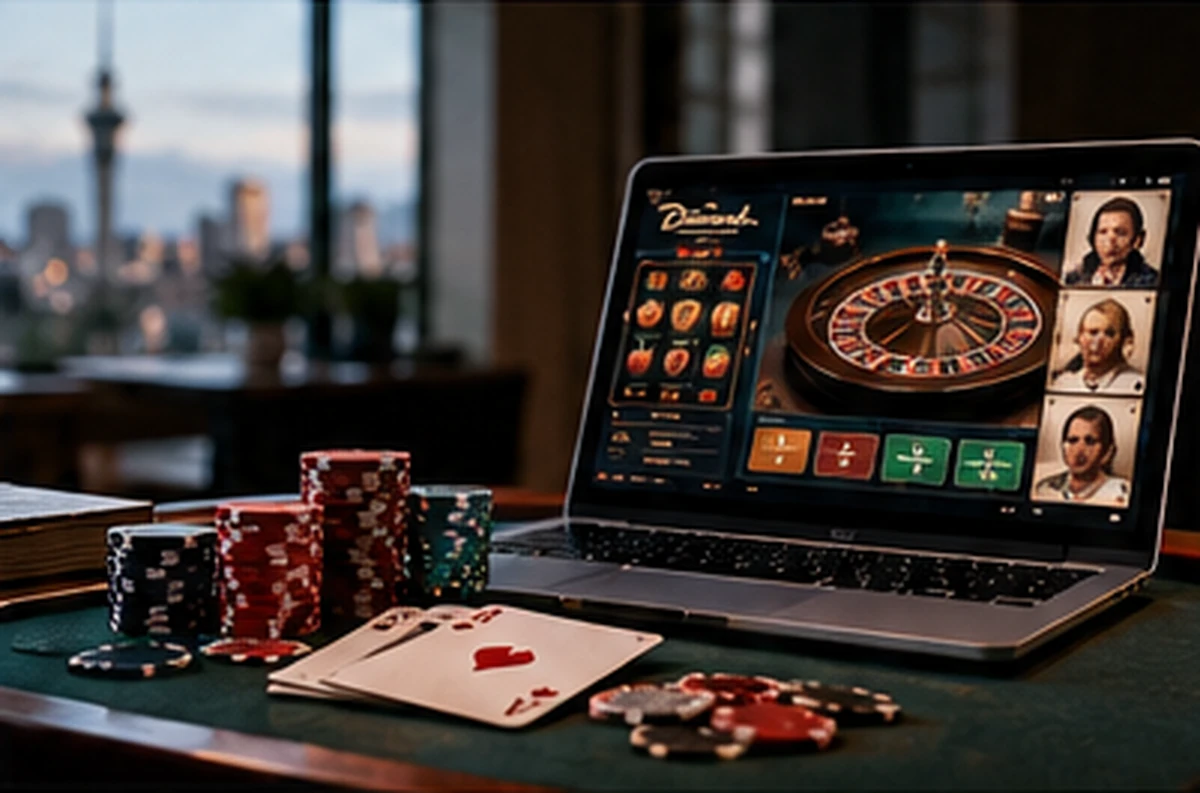
Games can place casino imagery inside an otherwise unrelated world. Poker, roulette, blackjack and slots appear as minigames; loot boxes use random rewards and reveal animations to build anticipation. The resemblance is visual and psychological, but it does not make every such mechanic a conventional bet.
That resemblance does not mean every loot box is legally gambling. Classification depends on the game's design, whether real-world value is involved and the applicable law. A useful distinction is to ask three questions: Is something of value paid or staked? Is the outcome substantially determined by chance? Can the reward be converted into something of real-world value? These questions clarify the mechanics; they are not a substitute for a legal assessment.
A streamer’s winning clip leaves out the unsuccessful attempts that preceded it. The same selection effect applies to rare loot-box rewards and short videos celebrating jackpots: a highlight is not a record of typical outcomes.
Gambling in NZ pop culture: beyond Las Vegas

Pokies, Lotto, TAB and the everyday Kiwi context
For a New Zealand audience, the most familiar gambling imagery may not be a tuxedo at a Monte Carlo baccarat table. It may be pokies in a pub or club, a Lotto NZ draw, Instant Kiwi tickets, or racing and sports betting associated with TAB NZ . Horse racing has a long local history; housie , a form of bingo, reflects a different social tradition. Older games such as two-up, fan-tan, pakapoo, pontoon and Crown and Anchor also belong to the wider historical vocabulary, although they are not equally visible in contemporary life.
That contrast explains why a Hollywood image of polished casino glamour cannot stand in for gambling culture in Aotearoa. Local settings bring in workmates, neighbourhood venues, sporting loyalties, community funding and the effects on families and whānau . Gambling harm also does not fall evenly across communities, according to the New Zealand Ministry of Health. Cultural representation should acknowledge people affected by gambling without suggesting that any ethnic community has a single attitude or experience.
Came a Hot Friday: a distinctly New Zealand gambling story
The 1985 film Came a Hot Friday , adapted from a novel by Taranaki writer Ronald Hugh Morrieson, offers a particularly local counterpart to Hollywood casino films. Gamblers Wes Pennington and Cyril Kidman exploit the time lag in rural bookmakers receiving horse-racing results in 1949. Their scheme leads to a night at an illegal casino operating from a woolshed, where events unravel. Billy T. James plays the Tainuia Kid.
Instead of the controlled grandeur of Bond’s casino, the film uses rural landscapes, pub networks and chaotic humour. A delayed racing result makes the con possible, a detail that would not work in the same way with modern live data. The Te Ara Encyclopedia of New Zealand records its place in New Zealand gambling history.
What New Zealand law means for casino culture in 2026
Pop-culture visibility must not be confused with legal permission to advertise or provide gambling services. New Zealand's Gambling Act 2003 remains central to the domestic framework, while the Online Casino Gambling Act 2026 took effect on 1 May 2026 . The Department of Internal Affairs (DIA) says the new online casino licensing regime is being introduced in stages and is not expected to be fully operational until 2027 .
A fictional character at a roulette table is a cultural reference; a real operator's brand, paid endorsement or sign-up link is a commercial signal. Judge the media by whether it invites someone to use a service, not by the presence of cards or casino imagery. The Department of Internal Affairs' advertiser guidance covers promotions aimed at New Zealand audiences.
Does pop culture glamorise gambling?
Often, yes. Editing turns hours of play into one decisive hand; music makes a roulette result feel momentous; a sharply dressed hero makes a casino look effortless. The losses that preceded the win rarely get equal screen time.
Yet Uncut Gems , Owning Mahowny and The Simpsons also show fixation, disruption and harm. Screen portrayals often leave out the following details:
| On screen or in a song | What the image leaves out |
|---|---|
| One last bet changes everything | More betting can increase losses; there is no guaranteed recovery. |
| A clever player defeats chance | Knowing a game is not the same as controlling its outcome. |
| The casino represents instant wealth | Casino games are structured around rules and long-run operator advantages. |
| A jackpot becomes a shared celebration | Family stress, debt and lost time may not be visible. |
| An influencer shows a spectacular win | Selected clips do not show the complete record or typical results. |
A familiar cultural reference can start a useful conversation about money, odds, advertising and personal boundaries. New Zealand's Ministry of Health describes gambling harm as a public-health issue affecting both people who gamble and those around them. If gambling is causing harm, support for individuals and whānau is more relevant than trying to imitate a fictional character's comeback.
Frequently asked questions
What is gambling in pop culture?
Gambling in pop culture means betting, casino games, lotteries and the language of chance appearing in films, television, music, books, games or online entertainment. Sometimes a character wagers money; sometimes a lyric borrows the metaphor.
Which films shaped gambling imagery?
Casino Royale , Casino , Ocean’s Eleven , Rounders and Uncut Gems popularised distinct images of casinos and betting, from glamour and heists to poker skill and compulsion.
Why is poker used so often in films and songs?
Poker gives a scene a visible contest of decisions and hidden information. Bluffing and folding also work as metaphors outside the game.
Is casino gambling portrayed realistically in movies?
Individual rules may be right, but films compress time and favour unlikely reversals. Dramatic wins say little about long-run odds.
What's a gambling pop culture example from NZ?
Came a Hot Friday is a clear example: its rural bookmakers, racing-results scheme and illegal woolshed casino connect gambling to a specifically New Zealand setting. The everyday terms pokies , Lotto and TAB also reflect the country's own gambling culture.
Are loot boxes the same as gambling?
No. Loot boxes may resemble gambling through chance and rewards, but legal classification depends on payment, prize value, design and jurisdiction.