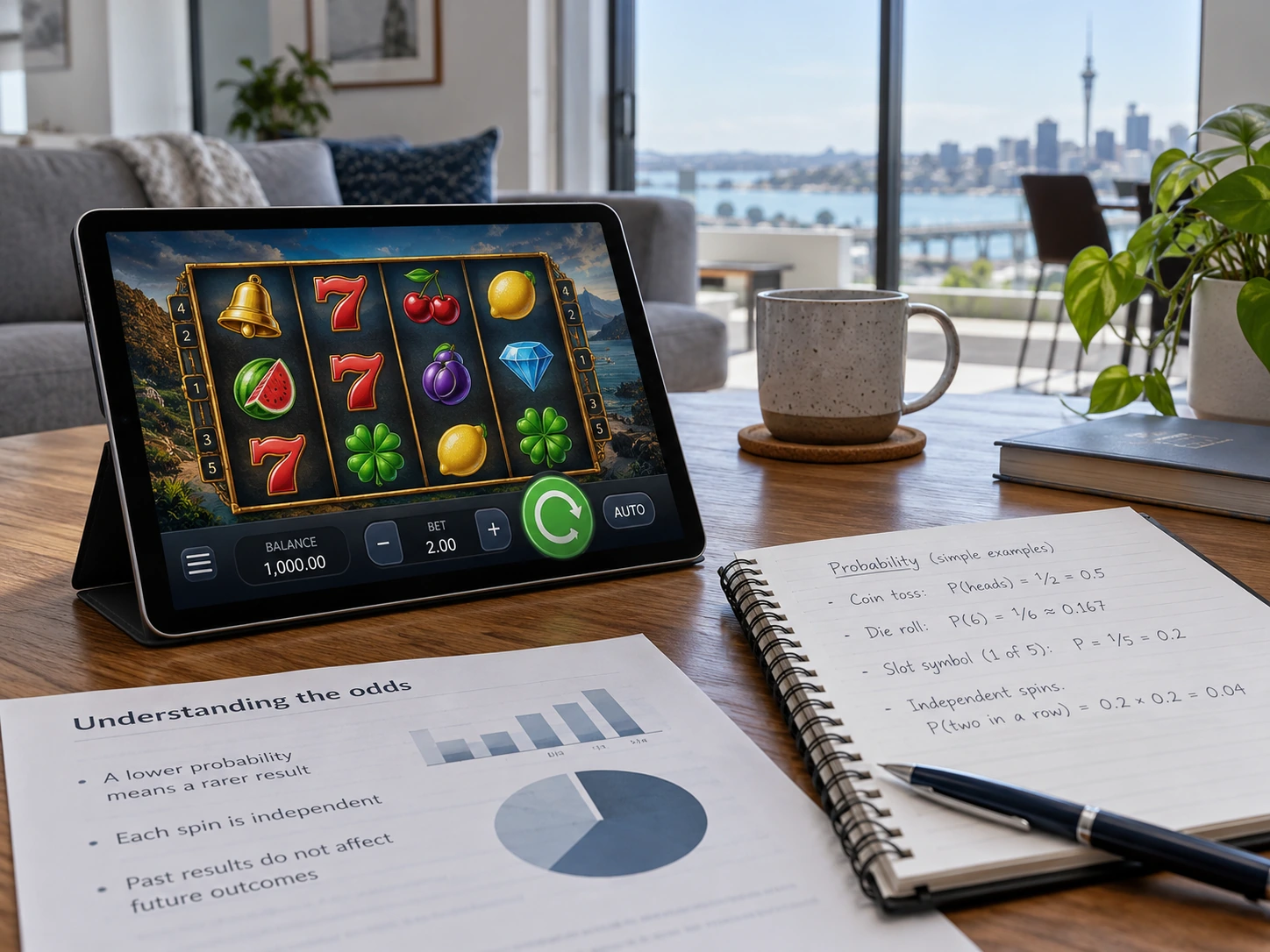
People naturally notice patterns and try to explain surprising events. In games with random outcomes, that habit can lead someone to see a streak as a signal, a near-miss as progress or a chosen button as a way to influence a result.
The Cognitive Blind Spot
Noticing a bias is not a measure of intelligence. Recognising common patterns can help a reader question a gambling claim, but it does not prevent harm on its own.
Common Gambling Biases
1. The Illusion of Control
First identified by Harvard psychologist Ellen Langer in 1975, the illusion of control describes an individual's tendency to overestimate their ability to influence random outcomes. In gambling, this manifests in numerous behaviours:
- Throwing craps dice gently for low numbers and aggressively for high numbers.
- Selecting personal lottery numbers based on family birthdays rather than quick-picks.
- Choosing specific pokie cabinets or pressing the stop button at precise moments.

2. Near-Misses
A near-miss is an unsuccessful outcome that appears close to a win under the game's display, such as two matching symbols appearing on a line while another stops nearby.
In one laboratory slot-machine study, near-misses increased participants' stated desire to continue and recruited some brain areas also responsive to wins. That result describes the task and participants in that study; a near-miss does not mean the next outcome is more likely to win.
3. Losses Disguised as Wins (LDWs)
A multi-line slot may return fewer credits than the total wager on a spin. For example, a NZ$2.00 wager that returns NZ$0.50 is a net loss of NZ$1.50, even if the game adds celebratory sounds or graphics. One study of 40 novice players measured arousal in response to this kind of outcome; its results do not establish how every player will react.
| Cognitive Bias | Psychological Mechanism | Common Player Rationalisation |
|---|---|---|
| Illusion of Control | Confusing passive participation with active skill | "I have a special touch when pressing the button" |
| Near-Miss Bias | Interpreting visual closeness as predictive progress | "The machine is almost ready to drop" |
| Availability Heuristic | Recalling memorable jackpot stories easily | "My mate won NZ$5,000 here last month" |
| Losses Disguised as Wins | Sensory cues masking net capital depletion | "I won four spins in a row" (while losing money) |

Overcoming Biases Through Mathematical Literacy
For a specific game, check its rules and displayed probabilities rather than treating recent outcomes or visual cues as a prediction. A past result does not show that a random game is about to pay.