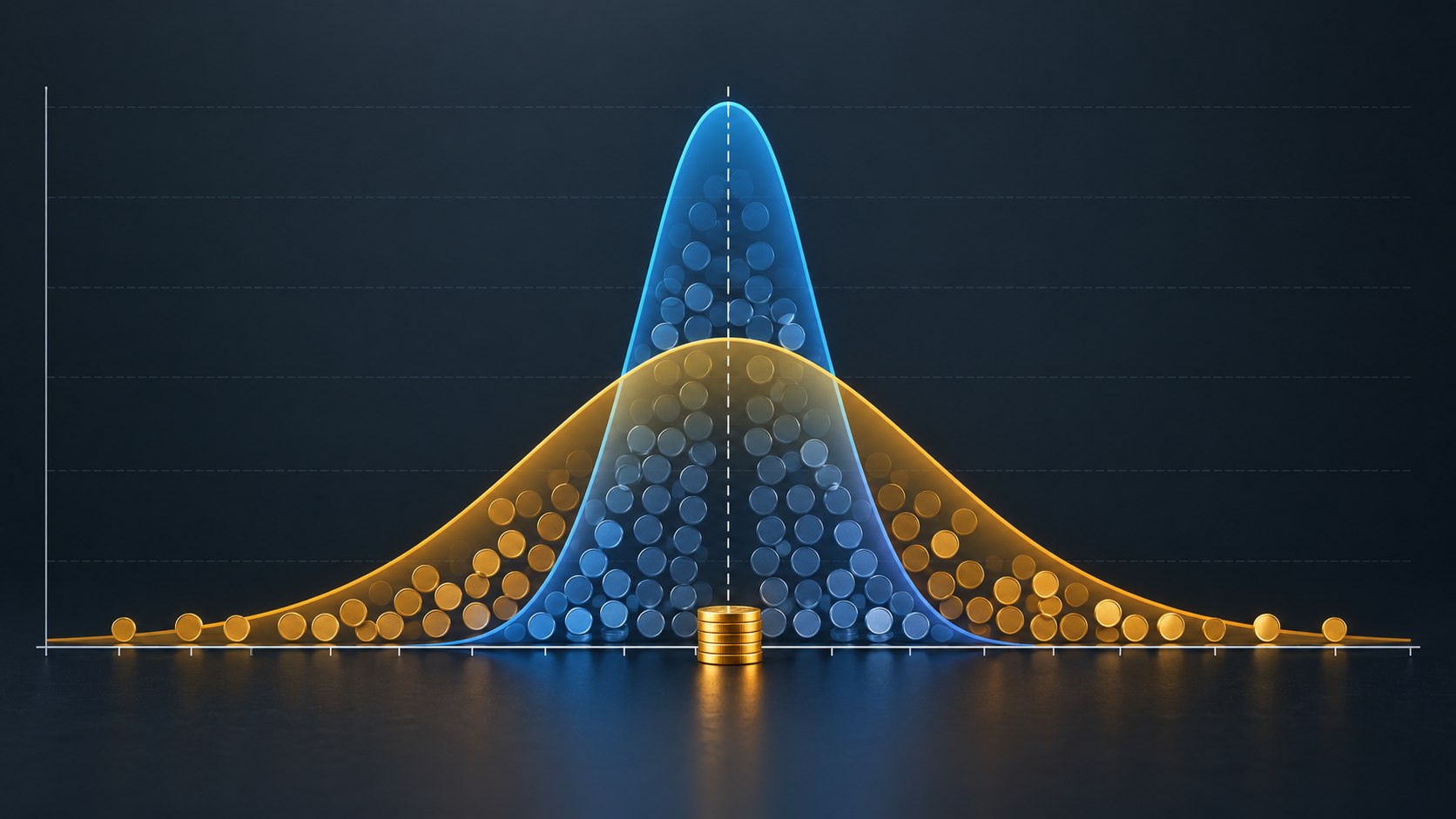
RTP (Return to Player) describes a slot’s theoretical average return over a very large number of wagers. Volatility describes how unevenly those returns are distributed. Two games with 96% RTP can pay in very different ways: frequent small prizes in one, long losing runs punctuated by a rare large win in the other. Neither figure predicts the next spin.
A 96% label says nothing about how often a slot pays, whether small prizes cover the stake or how heavily the maths relies on a rare bonus.
RTP vs volatility at a glance
| Question | RTP | Volatility |
|---|---|---|
| What does it measure? | Expected percentage of stakes returned over the game’s theoretical long run | How widely payouts vary around their expected value |
| How is it shown? | Usually a percentage, such as 96% | Often a low, medium or high label; sometimes a numerical measure |
| What does it help explain? | The mathematical share retained by the game across extensive play | Whether returns are spread across many smaller payouts or concentrated in fewer larger ones |
| What can it not tell you? | What you will receive in a particular session | When a win will occur, or the game’s long-run return percentage |
| What else should be checked? | Exact game version and RTP configuration | Hit frequency, paytable, bonus contribution and maximum win |
What does a 96% RTP actually mean?
RTP is built into a game’s mathematical model. A theoretical RTP of 96% means that, averaged across a sufficiently large volume of wagers under the specified rules, expected prizes total NZ$96 for every NZ$100 staked. The remaining 4% is the theoretical house edge . It does not mean that staking NZ$100 once, or making 100 spins, will return NZ$96.

For example, 200 spins at NZ$1 create NZ$200 in turnover. That is not necessarily the same as depositing NZ$200: winnings can be staked again, adding to turnover. Your individual result might be substantially above or below NZ$192 despite a 96% theoretical RTP.
House edge = 100% − theoretical RTP. Thus a 96% RTP corresponds to a 4% edge; 94% RTP corresponds to a 6% edge. That comparison is about expected cost, not what happens in a short session.
Actual RTP is a separate retrospective measurement: total prizes paid divided by total stakes, multiplied by 100. Over a small sample, actual RTP can sit far above or below the theoretical figure, particularly in volatile games.
What does slot volatility measure?
Volatility describes the dispersion of payouts. In technical game mathematics, variance and its square root, standard deviation , quantify spread. “Low”, “medium” and “high” are provider labels, not a universal scale. A medium-rated slot from one studio may behave differently from another studio’s medium-rated game.

Low volatility
Lower-volatility slots typically distribute more of their return through smaller, more frequent prizes. Balance movements may be less abrupt on average, but frequent payout messages do not guarantee that a session will break even. A NZ$0.20 win on a NZ$1 spin is still a net loss of NZ$0.80 for that spin.
Medium volatility
Medium volatility usually sits between frequent small payouts and infrequent large ones. It does not tell you the hit rate or how often a bonus lands.
High volatility
Higher-volatility slots typically place more of their expected return in relatively rare and larger prizes. Long dry spells and large balance fluctuations are possible, even when theoretical RTP matches that of a lower-volatility game. A 5,000× or 10,000× maximum win says how large a top prize can be, not how likely it is .
Why can equal RTP slots have different volatility?
Consider two deliberately simplified, hypothetical games. Both cost NZ$1 per spin and both have a theoretical RTP of 96%:

| Hypothetical payout model | Probability per spin | Prize | Expected return |
|---|---|---|---|
| Game A: win | 48% | NZ$2 | NZ$0.96 |
| Game A: no prize | 52% | NZ$0 | NZ$0 |
| Game B: win | 0.96% | NZ$100 | NZ$0.96 |
| Game B: no prize | 99.04% | NZ$0 | NZ$0 |
For Game A, 0.48 × NZ$2 = NZ$0.96 expected prize per NZ$1 stake. For Game B, 0.0096 × NZ$100 = NZ$0.96. The expected return is identical, but the payout distributions are dramatically different. Game A produces far more paying spins; Game B concentrates returns into rare events. These are teaching models, not descriptions of real casino games or predictions of session results.
The calculations show why RTP cannot tell you how erratic the payouts will be . Volatility, in turn, cannot tell you the expected return.
Where do hit frequency, RNG and game mechanics fit?
Hit frequency , also called hit rate, measures the proportion of spins meeting the game’s definition of a win. If 30 out of 100 spins pay any prize, the observed hit rate is 30%. That figure is not RTP. A paying spin may award less than the stake, so a high hit rate can coexist with a negative overall result. Published hit rates also depend on what the provider counts as a qualifying win.
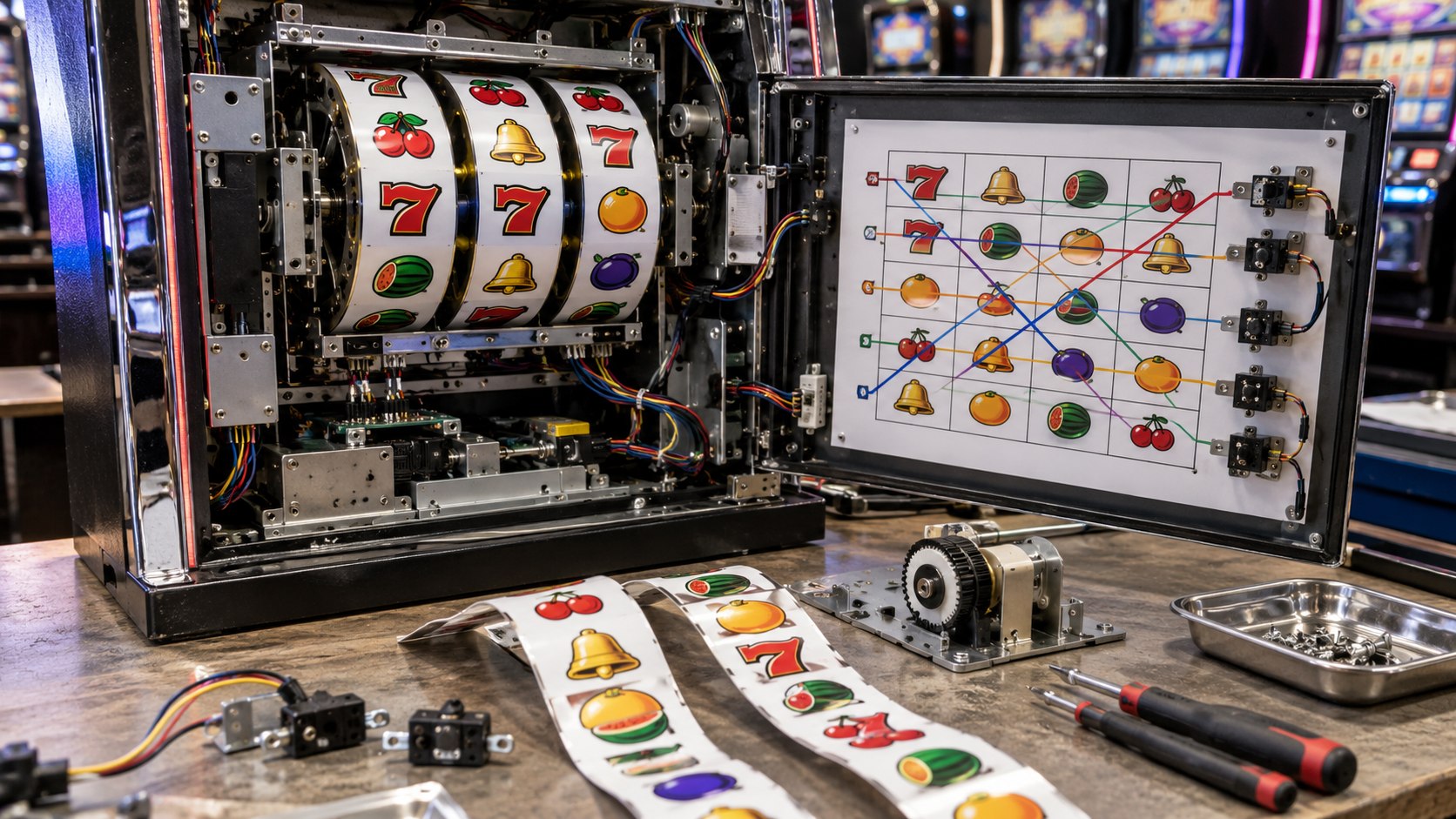
A random number generator (RNG) determines outcomes according to the game’s programmed probabilities. In a properly operating independent-spin slot, a losing streak does not make the next spin “due” to win. Treating a losing streak as a sign of an imminent win is the gambler’s fallacy .
The paytable sets out paying symbol combinations, wild symbols, scatter symbols, paylines or ways to win and prize multipliers. Reels and symbol animations show the outcome, but the underlying mathematical model determines the probabilities. Free spins, bonus rounds, multipliers and bonus-buy features (where offered) can shift how much theoretical return comes from the base game versus rarer events.
A progressive jackpot may add an infrequent, very large payout component. Its contribution and conditions must be assessed separately rather than assuming the advertised base-game RTP includes every jackpot or side-bet variation. The same caution applies to optional stakes and feature purchases: read the rules for the exact mode being used.
Which statistic matters when comparing two games?
Start with the question you are actually trying to answer. If it is “Which game has the lower theoretical cost per dollar wagered?”, compare verified RTP figures for the specific versions on offer. If it is “How uneven could the payouts be?”, examine volatility, hit frequency and how prizes are distributed between base play, bonuses and jackpots. Neither statistic makes a negative-expectation game profitable.
- Same RTP, different volatility: the long-run average matches, but payout patterns can differ substantially.
- Same volatility label, different RTP: the games may feel broadly similar while carrying different theoretical house edges.
- High hit frequency, low net return: many small prizes may fail to cover the cost of spins.
- Large maximum win, unknown probability: the top prize does not indicate how often it can be reached.
- Different RTP configurations: a familiar game name does not guarantee the same return setting across platforms.
Your bankroll and stake size affect how much money is exposed to each result; they do not alter RTP. A loss limit can restrict spending, not the house edge. Even a low-volatility game can exhaust a budget.
How to check a slot’s RTP and volatility before playing
- Open the game rules or information screen. Look for “RTP”, “Return to Player”, “game information” or a help icon. Confirm the actual percentage rather than assuming a figure from an older review.
- Identify the exact variant. Games with identical names can have different RTP configurations, bonus options or versions. Check whether figures apply to the base game, an optional feature or the complete game.
- Read the paytable. Identify the stake, winning combinations, bonus triggers, maximum payout, jackpot eligibility and any qualifying conditions.
- Treat volatility ratings as relative. If the provider does not publish a numerical volatility measure or comparable hit frequency, avoid claiming precision that the rules do not provide.
- Check the operator’s status and spending tools. Confirm applicable consumer protections and set a loss limit before wagering. If the game information is unclear, do not infer missing numbers from promotional descriptions.
What should players in New Zealand know?
New Zealand is introducing online-casino licences in stages. A site being accessible from the country does not by itself show that local operator requirements apply; check the operator's status before relying on its game disclosures.
The Online Casino Gambling Regulations 2026 establish consumer-information requirements for licensed operators, including access to game rules and, before first play, the odds of winning and defined RTP where applicable. They also address presentation of monetary values in New Zealand dollars. The effective obligations must be understood in the context of the staged licensing regime, rather than assumed to apply uniformly to every currently accessible offshore service.
For gambling-related support in New Zealand, the Gambling Helpline can be contacted on 0800 654 655 or by texting 8006 . Safer Gambling Aotearoa also provides local information and support. Neither statistic makes gambling safe.
Frequently asked questions
Does a higher RTP mean I will win more often?
No. RTP measures average expected return, not win frequency. A higher-RTP game can still award prizes infrequently or contain many payouts smaller than the original stake.
Is low volatility always better than high volatility?
Not necessarily. Lower volatility generally means smaller fluctuations; higher volatility means greater swings. Both can lose money.
Can 100 spins confirm whether a game has 96% RTP?
No. A 100-spin sample is too small to validate most slot models. Actual RTP can depart sharply from the theoretical figure over short periods, especially when rare bonuses contribute heavily to expected returns.
Are RTP, variance and hit rate interchangeable?
No. RTP is the expected return percentage; variance describes spread around the mean; standard deviation is the square root of variance; and hit rate counts how often a defined payout event occurs.
Can a bonus buy or jackpot change the comparison?
Yes. Optional features may have separate rules and mathematical properties. A jackpot can introduce very rare payouts and substantial volatility. Check which game mode the displayed RTP covers before comparing figures.
Can I use RTP and volatility to predict my next spin?
No. In an independent-spin game, past results do not change the odds of the next spin.